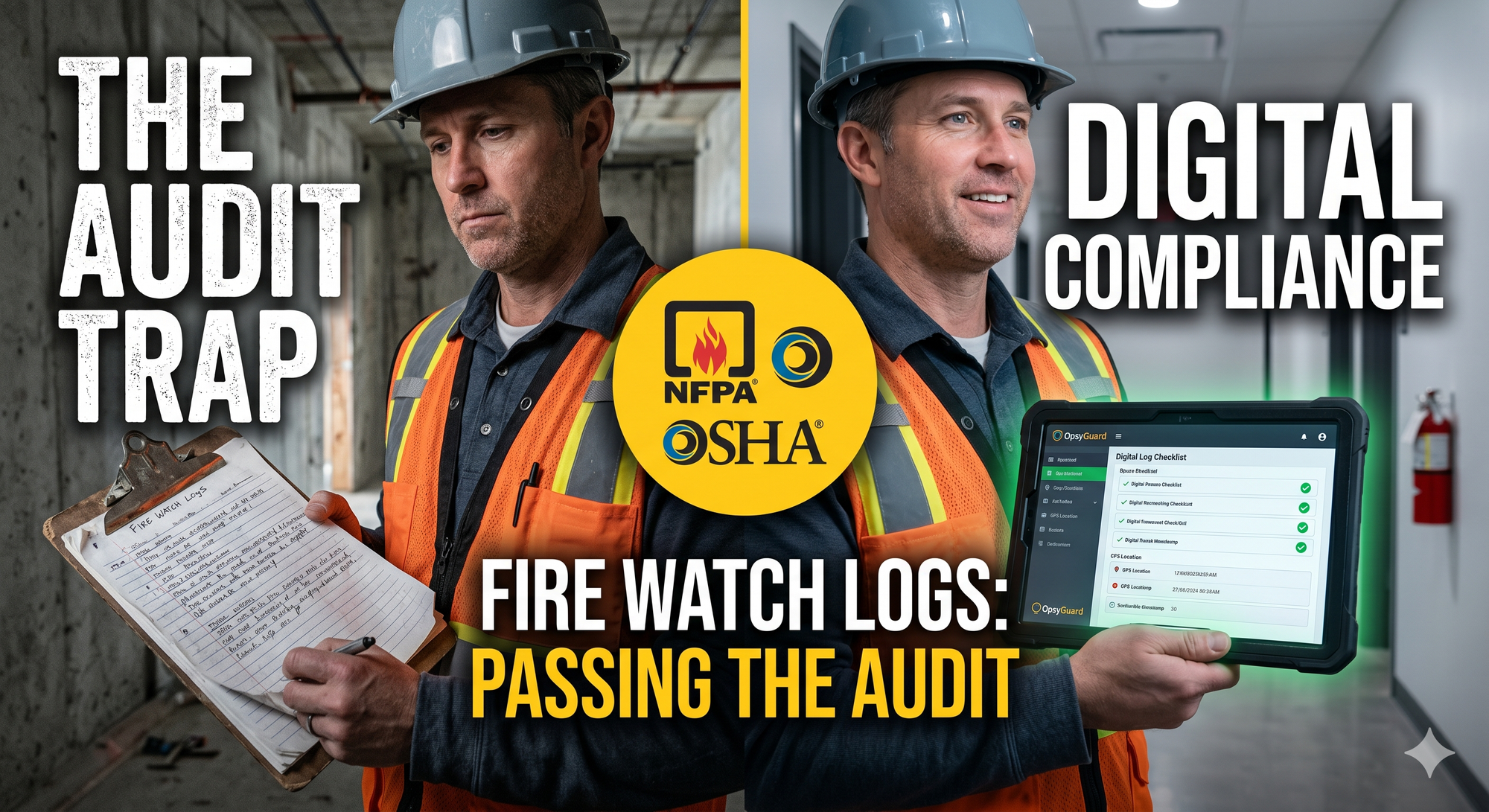
When a fire marshal walks onto your site, they are looking for one thing above all else: proof. Proof that your site is safe, proof that protocols are being followed, and proof that if a system goes down, human oversight has immediately taken its place.
Failing to provide this proof doesn't just result in a slap on the wrist. Non-compliance with fire watch regulations can lead to severe OSHA fines, immediate work stoppage orders, and invalidated insurance policies.
For facility managers and security operators, understanding the strict compliance requirements of a fire watch is the only way to protect your site and your bottom line. Here is a breakdown of the core regulations you need to know and how to ensure your logs survive an audit.
The Core Regulations: NFPA and OSHA
The rules governing fire watch operations are primarily written by the National Fire Protection Association (NFPA) and enforced by local Authorities Having Jurisdiction (AHJs), such as your local fire marshal, alongside the Occupational Safety and Health Administration (OSHA).
Here are the critical standards every safety officer must be familiar with:
- NFPA 101 (Life Safety Code): This dictates that if a required fire alarm or sprinkler system is out of service for more than 4 hours in a 24-hour period, the building must either be evacuated or an approved fire watch must be provided for all parties left unprotected.
- NFPA 51B (Standard for Fire Prevention During Welding, Cutting, and Other Hot Work): This is the bible for construction sites. It legally mandates a dedicated fire watch during any hot work operation and requires the watch to be maintained for at least 30 to 60 minutes after the work is completed to monitor for smoldering embers.
- OSHA 29 CFR 1910.252: OSHA’s standard reinforces NFPA 51B, explicitly stating that employers must provide a fire watch when hot work is performed in locations where other than a minor fire might develop.
The Audit Trail: Why Paper Logs Fail
Knowing the rules is only half the battle; proving you followed them is where most operations fail. The fire marshal will demand to see your fire watch log.
Historically, this meant handing over a crumpled clipboard. Paper logs are a massive compliance liability for several reasons:
- Pencil Whipping: Guards can easily fill out an entire shift's worth of log entries in five minutes while sitting in a breakroom.
- Illegibility and Damage: Water damage, terrible handwriting, and lost clipboards mean the data is gone forever. If you can't read it, it didn't happen.
- Lack of Real-Time Verification: Management has no idea if the guard is actually walking the perimeter until the shift is over and the paper is turned in.
The Digital Compliance Standard
To truly bulletproof your operations against audits, migrating from paper to a digital fire watch application is no longer just a luxury—it is the new industry standard.
When evaluating a digital solution, the underlying technology matters just as much as the features. Modern fire watch platforms engineered with robust, enterprise-grade architectures—such as those utilizing secure NestJS backends for high-speed data processing and cross-platform frameworks like Angular and Ionic for the mobile interface—ensure maximum reliability. This tech infrastructure guarantees that even if a guard is deep in a concrete basement with a spotty connection, their offline logs will securely and instantly sync the moment they reconnect.
A digital system ensures compliance by providing:
- GPS and Time-Stamped Proof: Every log entry is pinned with exact geographic coordinates and an unalterable timestamp, proving exactly where the guard was and when.
- Mandatory Photo Evidence: Guards can snap photos of cleared hot work areas or mitigated hazards, providing undeniable visual proof to auditors.
- Instant Cloud Archiving: Logs are stored securely in the cloud, meaning facility managers can instantly generate and email a pristine, formatted PDF report to a fire marshal the second they ask for it.
Compliance is not about checking boxes; it is about verifiable life safety. By understanding the strict requirements of the NFPA and OSHA, and by arming your team with reliable digital tools, you eliminate the stress of the audit and ensure your site remains open, operational, and fundamentally safe.