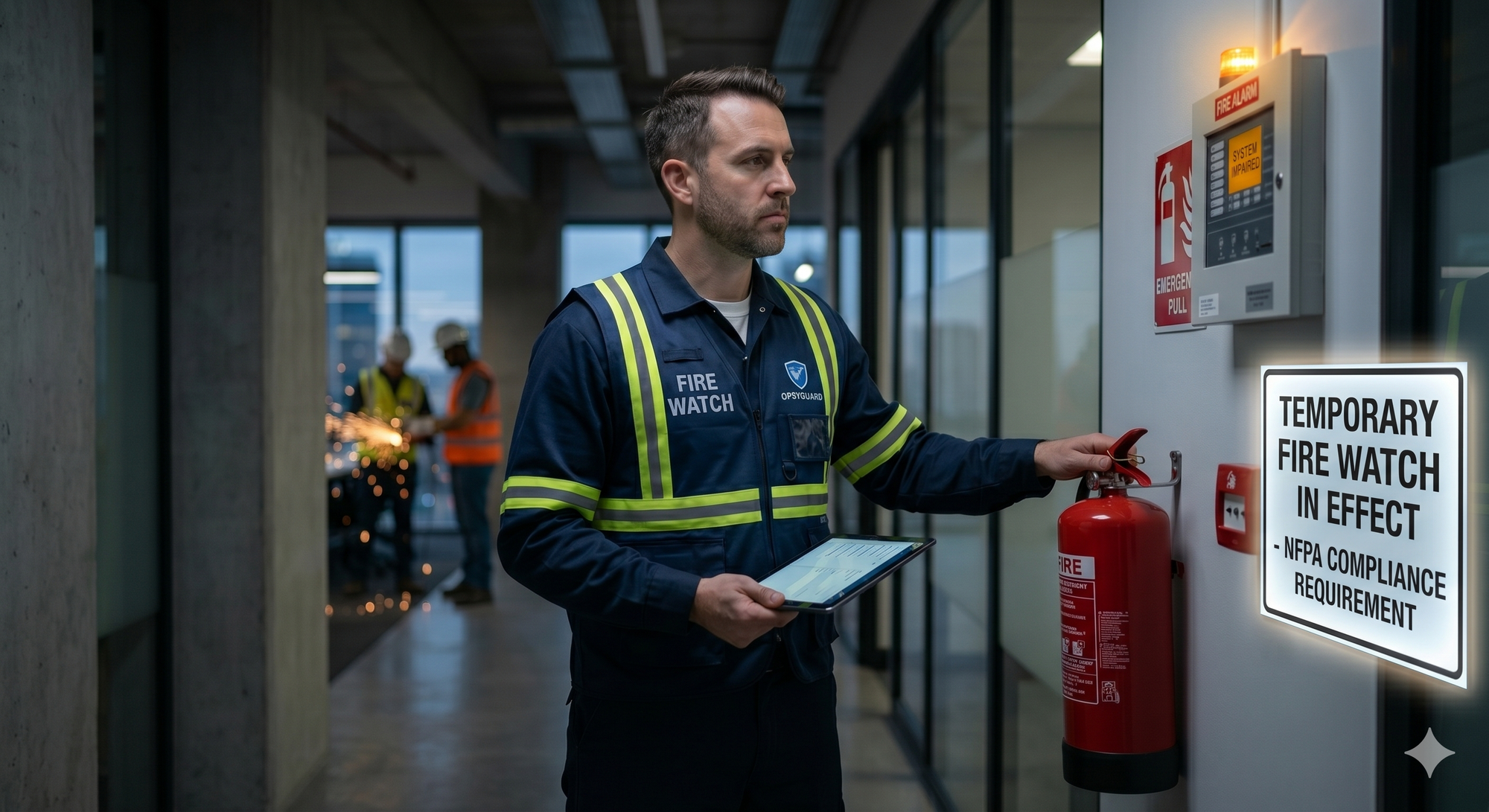
Imagine discovering that your building’s entire fire alarm system has gone offline due to a technical fault. Or perhaps, your construction team needs to perform critical welding that sparks directly adjacent to flammable materials.
In these moments, your automated fire protection systems are either compromised or simply insufficient. The risk of an undetected fire starting and spreading rapidly skyrockets. This is precisely when a mandatory, human-led operation known as a Fire Watch is legally required.
But what exactly is a fire watch, who is qualified to perform it, and what are the specific scenarios that mandate its implementation? For property managers, construction supervisors, and compliance officers, understanding these requirements is non-negotiable for ensuring site safety and avoiding severe regulatory penalties.
Defining the Fire Watch
A fire watch is a short-term, dedicated safety measure where a qualified individual is assigned the sole responsibility of continuously monitoring a specific area for the presence of fire hazards, smoke, or flames.
The NFPA (National Fire Protection Association) defines a fire watch as:
"A person or persons assigned to an area for the express purpose of notifying the fire department, the building occupants, or both of an emergency; preventing a fire from occurring; extinguishing small fires; or protecting the public from fire or life safety dangers."
Unlike a generic security guard whose duties might involve access control or anti-theft patrols, a fire watch has a singular, life-safety focus. Their primary function is detection and immediate reporting.
Key Scenarios: When is a Fire Watch Required?
A fire watch is not a suggestion; it is a regulatory requirement mandated by international fire codes (like the IFC), OSHA standards, and NFPA protocols (primarily NFPA 101 and NFPA 1).
A fire watch becomes mandatory in four primary situations:
1. Impaired or Out-of-Service Fire Protection Systems
This is the most common reason a fire watch is ordered by a Fire Marshal. If a building’s mandatory fire protection systems—such as fire alarms, smoke detectors, or automatic sprinkler systems—are impaired (partially or fully out of service) for a significant amount of time, a human backup is required. The specific timeline varies (e.g., more than 4 hours in a 24-hour period in some jurisdictions), but the core rule is simple: if the system cannot detect or suppress, a human must watch.
2. Hot Work Operations
"Hot work" is any activity involving open flames, sparks, or heat that could ignite flammable materials. This includes welding, cutting, brazing, grinding, and soldering.
NFPA 51B specifically requires a dedicated fire watch during all hot work operations and, critically, for a minimum of 30 minutes after the work is completed to ensure no smoldering embers ignite. (In complex environments, this post-work watch can be extended to 60 minutes or longer).
3. Construction and Demolition Sites
Active construction and demolition sites are dynamic, high-hazard environments. Temporary electrical setups, accumulation of debris, and the frequent use of hot work make these sites vulnerable. Fire codes often mandate continuous fire watch presence during non-working hours, weekends, or during specific hazardous phases of construction.
4. Special Events or Unique Hazard Conditions
Occasionally, unique circumstances may create a temporary spike in fire risk. This can include large public assemblies in venues with compromised egress, extreme weather events (like an incoming wildfire threat near a critical facility), or the temporary storage of hazardous materials. Local authorities may mandate a fire watch until the unique hazard condition subsides.
Duties and Responsibilities of a Fire Watch Guard
The role of a fire watch is active, demanding continuous movement and sharp observation. They are expected to:
- Maintain Continuous Patrol: The guard must physically walk and monitor the entire affected area without interruption.
- Identify and Mitigate Hazards: They must actively look for potential ignition sources, blocked exits, accumulated flammable materials, and unsafe practices (like unauthorized hot work).
- Operate Fire Extinguishers (If Safe): Fire watch personnel must be trained in the basic use of fire extinguishers and attempt to control very small, nascent fires only if it is safe to do so. Their first priority remains notification.
- Immediate Emergency Reporting: If a fire occurs, the fire watch must immediately sound the internal building alarm and contact emergency services (911). They must know the precise location to give to dispatchers.
- Keep Meticulous Logs: This is a crucial compliance step. The guard must log their activity, usually every 15 to 30 minutes, recording the time of patrol, conditions observed, and any actions taken. These logs create an audit trail proving compliance during the system impairment or hot work.
Conclusion
A fire watch is a critical safeguard, stepping in when systems fail or hazards are extreme. For any stakeholder responsible for a facility, understanding the mandatory compliance scenarios and the gravity of the guard’s duties is the first step in effective risk management.
Managing this entire process—from scheduling patrols to maintaining illegible paper logs—has traditionally been a major operational headache. Solutions like OpsyGuard are moving this vital safety function into the digital age, allowing for real-time tracking, digital logging, and seamless compliance reporting.