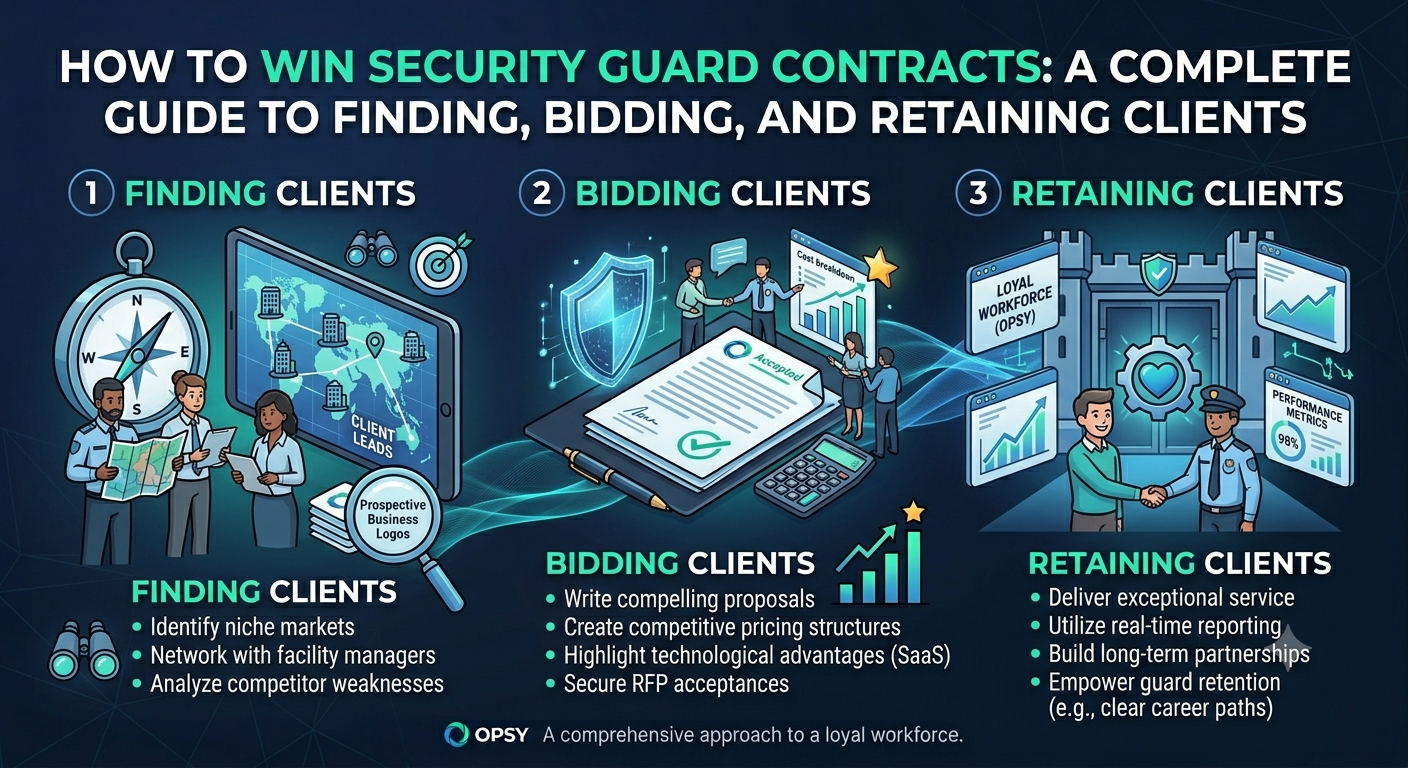
How to Win Security Guard Contracts: A Complete Guide
Winning security contracts is one of the biggest challenges for both new and established security companies. Competition is often fierce, clients expect competitive pricing, and businesses want proof that your company can deliver reliable, professional protection.
However, winning contracts isn't just about offering the lowest price. Successful security companies build trust, demonstrate operational excellence, and show potential clients exactly how they will reduce risk and improve safety.
In this guide, you'll learn how to find security contract opportunities, prepare competitive proposals, stand out from competitors, and retain clients long after the contract is signed.
Understand What Clients Are Really Buying
Many security companies believe they sell guards.
In reality, clients buy:
- Peace of mind
- Risk reduction
- Reliable coverage
- Professional communication
- Accountability
- Fast incident response
Every proposal should explain how your company delivers these outcomes—not simply how many guards you can provide.
Identify Your Ideal Clients
Trying to serve everyone often leads to poor results.
Instead, focus on industries where you can build expertise.
Common markets include:
- Commercial office buildings
- Retail centers
- Construction sites
- Warehouses
- Manufacturing facilities
- Residential communities
- Healthcare facilities
- Schools and universities
- Hotels
- Special events
Specialization makes your company easier to recommend and helps justify premium pricing.
Where to Find Security Contract Opportunities
Security contracts come from multiple sources.
Local Businesses. Reach out to:
- Property management companies
- Facility managers
- Commercial landlords
- Business parks
- Shopping centers
Many businesses review security providers annually.
Government Contracts. Government agencies regularly publish requests for proposals (RFPs). These opportunities often include:
- Municipal buildings
- Public transportation
- Schools
- Government offices
- Infrastructure
Although the bidding process can be more complex, government contracts often provide stable, long-term revenue.
Construction Projects. Construction sites frequently require:
- Overnight security
- Mobile patrols
- Equipment protection
- Access control
Building relationships with construction firms can generate recurring work.
Referrals. Satisfied clients remain one of the best sources of new business.
Encourage referrals by consistently delivering excellent service and maintaining regular communication.
Build a Professional Sales Process
Winning contracts rarely happens after a single meeting.
Develop a repeatable sales process that includes:
- Lead generation
- Initial discovery call
- Site assessment
- Risk evaluation
- Security proposal
- Contract negotiation
- Service implementation
Documenting your sales process ensures consistency as your company grows.
Conduct a Thorough Site Assessment
Never submit a proposal without understanding the client's environment.
Evaluate:
- Entry and exit points
- Existing security measures
- High-risk areas
- Visitor traffic
- Patrol routes
- Emergency procedures
A detailed assessment demonstrates professionalism and allows you to recommend the appropriate level of protection.
Create a Winning Security Proposal
Your proposal should solve the client's problems—not simply list your services.
A strong proposal typically includes:
Executive Summary. Summarize the client's challenges and your recommended solution.
Scope of Services. Clearly define:
- Guard responsibilities
- Patrol frequency
- Shift schedules
- Access control procedures
- Emergency response
Staffing Plan. Explain:
- Number of guards
- Supervisor coverage
- Backup procedures
- Training standards
Technology. Show how your company uses technology to improve service. Examples include:
- Digital patrol reports
- GPS verification
- Incident reporting
- Real-time updates
- Client dashboards
Technology demonstrates accountability and differentiates your company from competitors.
Price Your Services Strategically
Many companies lose money by underpricing contracts.
Instead of competing only on cost, explain the value your service provides.
Your pricing should account for:
- Employee wages
- Payroll taxes
- Insurance
- Equipment
- Administration
- Technology
- Profit margin
Clients often choose the proposal that offers the best value—not necessarily the lowest price.
Demonstrate Operational Excellence
Clients want confidence that your company can manage day-to-day operations effectively.
Explain your processes for:
- Guard scheduling
- Shift coverage
- Supervisor inspections
- Incident reporting
- Quality assurance
- Emergency communication
Showing well-defined operational processes builds trust before the contract even begins.
Deliver Outstanding Client Reporting
Winning a contract is only the beginning.
Regular reporting strengthens transparency and reinforces the value of your services.
Share reports that include:
- Patrol activity
- Incident summaries
- Response times
- Missed patrols (if any)
- Corrective actions
- Performance metrics
Professional reporting helps clients understand exactly what they're paying for.
Develop Clear Post Orders
Every security post should have written instructions.
Post orders typically include:
- Site overview
- Guard responsibilities
- Patrol routes
- Emergency contacts
- Access procedures
- Incident reporting requirements
- Escalation process
Well-written post orders improve consistency across shifts and reduce mistakes.
Standardize Your SOPs
Standard Operating Procedures (SOPs) ensure every guard follows the same processes.
Examples include:
- Visitor management
- Incident response
- Lost property procedures
- Alarm response
- Fire evacuation
- Medical emergencies
- Shift handovers
Consistent SOPs improve service quality and simplify training.
Retain Clients Through Communication
Many security contracts are renewed because of communication—not price.
Schedule regular review meetings to discuss:
- Recent incidents
- Performance metrics
- Client feedback
- Improvement opportunities
- Future security needs
Proactive communication strengthens long-term relationships.
Use Technology to Differentiate Your Company
Modern clients increasingly expect digital visibility into security operations.
Platforms like OPSY help security companies provide:
- Live guard activity
- Digital incident reports
- Shift verification
- GPS patrol tracking
- Task management
- Performance insights
Providing real-time operational transparency can become a significant competitive advantage during both sales and contract renewals.
Common Mistakes When Pursuing Security Contracts
Avoid these common pitfalls:
- Competing only on price
- Submitting generic proposals
- Skipping site assessments
- Poor communication after contract award
- Inconsistent reporting
- Outdated paper-based processes
Each of these mistakes can reduce client confidence and impact renewals.
Frequently Asked Questions
How do security companies find contracts?
Security companies typically generate business through networking, referrals, online marketing, government tenders, property management partnerships, and direct outreach.
Should I bid lower than competitors?
Not necessarily. Many clients prioritize reliability, professionalism, and accountability over the lowest price.
What should a security proposal include?
A proposal should cover the client's needs, recommended services, staffing, pricing, operational processes, reporting methods, and technology used to manage security operations.
How can I improve client retention?
Consistent communication, transparent reporting, well-trained guards, and proactive service improvements are key factors in retaining long-term security contracts.
Final Thoughts
Winning security contracts requires more than competitive pricing. Companies that understand their clients' risks, present tailored solutions, communicate effectively, and demonstrate operational excellence are far more likely to succeed.
Once a contract is awarded, standardized procedures, clear reporting, and modern workforce management become essential for maintaining service quality and earning renewals.
The companies that consistently grow are those that combine professional security personnel with efficient systems that create transparency, accountability, and trust.