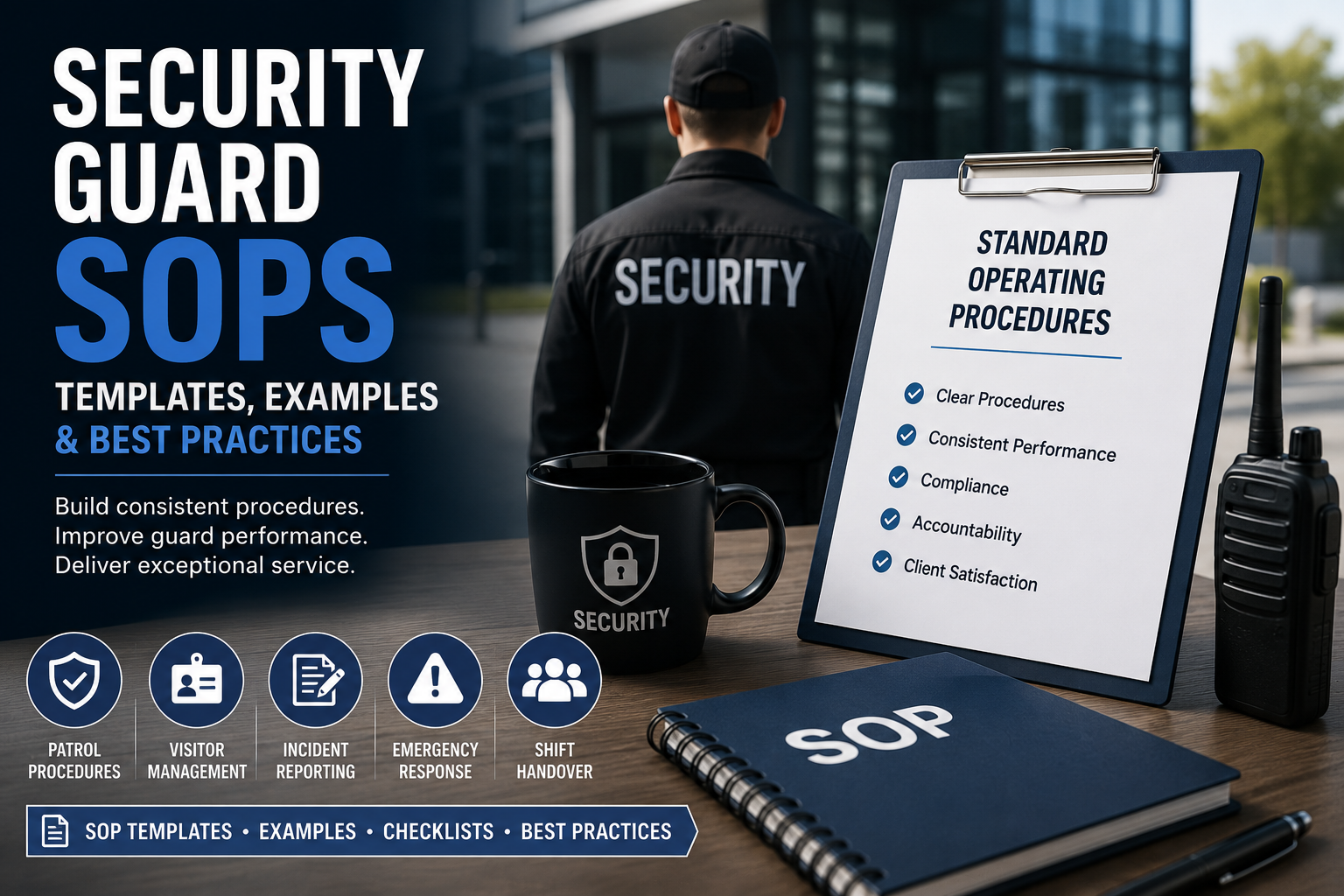
Security Guard SOPs: Templates, Examples & Best Practices
Every successful security company depends on consistency. Whether your guards protect a construction site, corporate office, hospital, or residential community, clients expect every officer to respond professionally and follow the same procedures every time.
That's where Standard Operating Procedures (SOPs) come in.
Security Guard SOPs provide clear, written instructions that define how guards should perform routine duties, respond to incidents, communicate with supervisors, and handle emergencies. Well-written SOPs improve service quality, simplify training, reduce mistakes, and help security companies meet compliance requirements.
This guide explains what Security Guard SOPs are, why they matter, what they should include, and provides practical templates and examples you can adapt for your own organization.
What Are Security Guard SOPs?
A Standard Operating Procedure (SOP) is a documented process that explains exactly how a security officer should perform a specific task.
Instead of relying on individual judgment alone, SOPs create standardized workflows so every guard follows the same expectations.
Typical SOPs cover:
- Beginning a shift
- Conducting patrols
- Access control
- Visitor management
- Incident reporting
- Emergency response
- Shift handovers
- Communication protocols
- Lost property
- Alarm response
Well-documented procedures help ensure consistent service regardless of which guard is on duty.
Why SOPs Are Important for Security Companies
As a security company grows, maintaining consistent service becomes more difficult.
Without documented procedures, different guards may respond differently to the same situation. This inconsistency can increase risk, reduce client satisfaction, and create liability.
Effective SOPs help companies:
- Standardize operations across all sites
- Improve guard accountability
- Reduce training time
- Support regulatory compliance
- Improve communication
- Deliver more consistent client service
- Simplify performance evaluations
For clients, SOPs demonstrate professionalism and show that your company follows structured operational standards.
What Every Security Guard SOP Should Include
Although every location has unique requirements, most SOPs follow a similar structure.
Purpose
Clearly explain why the procedure exists.
Example:
"To establish a consistent process for conducting hourly patrols and documenting security observations."
Scope
Define where and when the SOP applies.
Example:
"This procedure applies to all unarmed security officers assigned to commercial office properties."
Responsibilities
Identify who is responsible.
Examples include:
- Security Officer
- Site Supervisor
- Operations Manager
- Client Representative
Clearly defining responsibilities reduces confusion during daily operations.
Required Equipment
List the equipment guards need before beginning the task.
Examples:
- Uniform
- Radio
- Mobile phone
- Flashlight
- Body camera
- Incident reporting app
- Access credentials
Step-by-Step Procedure
This is the most important section.
Instructions should be clear, sequential, and easy to follow.
Use numbered steps rather than long paragraphs whenever possible.
Documentation Requirements
Specify what must be recorded.
Examples include:
- Patrol completion
- Visitor logs
- Incident reports
- Photos
- Vehicle inspections
- Maintenance issues
Good documentation protects both the security company and its clients.
Example SOP: Beginning a Shift
Objective
Ensure every guard starts their shift prepared and informed.
Procedure
- Arrive at least 15 minutes before the scheduled shift.
- Sign in according to company policy.
- Inspect uniform and required equipment.
- Review the previous shift's logbook.
- Check for new client instructions.
- Test communication devices.
- Confirm emergency contact information.
- Begin patrol or assigned duties on schedule.
Example SOP: Patrol Procedures
Regular patrols are one of the most common security responsibilities.
Patrol Checklist
- Follow designated patrol routes.
- Check all access points.
- Verify doors and windows are secure.
- Observe for suspicious activity.
- Identify safety hazards.
- Document maintenance concerns.
- Report unusual findings immediately.
- Complete digital patrol logs.
Randomized patrol schedules can help improve effectiveness by reducing predictability.
Example SOP: Visitor Management
Visitor procedures should protect both security and customer experience.
Typical process:
- Greet visitors professionally.
- Verify identification.
- Confirm authorization.
- Issue visitor badge.
- Record visitor information.
- Notify host.
- Collect badge upon departure.
Every visitor interaction should be documented according to company policy.
Example SOP: Incident Reporting
Accurate reporting is one of the most valuable services a security company provides.
Every report should include:
- Date and time
- Exact location
- People involved
- Description of events
- Actions taken
- Evidence collected
- Photos (if applicable)
- Witness information
Reports should remain factual and avoid personal opinions.
Digital reporting systems make incident documentation faster, more accurate, and easier to share with clients.
Example SOP: Emergency Response
Every site should have clearly documented emergency procedures.
Common emergency scenarios include:
Fire
- Activate emergency procedures.
- Notify emergency services.
- Assist evacuation if safe.
- Secure access routes.
- Document the incident.
Medical Emergency
- Contact emergency responders.
- Provide first aid if certified.
- Protect the surrounding area.
- Record all actions taken.
Unauthorized Entry
- Assess the situation safely.
- Notify supervisors.
- Contact law enforcement if necessary.
- Preserve evidence.
- Complete an incident report.
Emergency SOPs should be reviewed and practiced regularly.
Example SOP: Shift Handover
Poor shift handovers are a common cause of communication failures.
A proper handover should include:
- Outstanding incidents
- Equipment issues
- Visitors remaining onsite
- Open maintenance requests
- Patrol status
- Client instructions
- Scheduled deliveries
A standardized handover reduces the risk of missed information.
Best Practices for Writing Security SOPs
Well-written SOPs should be:
Clear
Avoid technical jargon when simple language is sufficient.
Every guard should easily understand the instructions.
Consistent
Use the same formatting throughout every procedure.
Consistency makes documents easier to follow.
Practical
SOPs should reflect actual field operations—not idealized scenarios.
Involve experienced supervisors when developing procedures.
Regularly Updated
Review SOPs whenever:
- Client requirements change
- New technology is introduced
- Regulations are updated
- Operational issues are identified
Outdated procedures can create unnecessary risks.
Common Mistakes to Avoid
Many companies create SOPs that are never used.
Common mistakes include:
- Writing procedures that are too long
- Using vague language
- Not training guards on SOPs
- Failing to update documentation
- Ignoring client-specific requirements
- Keeping procedures only on paper
SOPs should be living documents that evolve with your operations.
How Technology Improves SOP Compliance
Traditional paper manuals are difficult to maintain and nearly impossible to monitor.
Modern security companies increasingly use digital platforms to:
- Assign post-specific procedures
- Deliver updated instructions instantly
- Track completed patrols
- Verify task completion
- Collect digital incident reports
- Maintain audit trails
Providing guards with mobile access to SOPs ensures they always have the latest procedures available while on duty.
Sample Security Guard SOP Template
You can use the following structure when creating your own procedures.
SOP Title
Purpose
Scope
Responsibilities
Required Equipment
Procedure
Documentation Requirements
Related Forms
Emergency Contacts
Revision History
Keeping a consistent format across all SOPs makes them easier to manage and update as your company grows.
Frequently Asked Questions
How often should Security Guard SOPs be reviewed?
Most security companies review SOPs at least once a year or whenever client requirements, regulations, or operational processes change.
What's the difference between SOPs and Post Orders?
SOPs define company-wide procedures and standards, while Post Orders contain site-specific instructions for a particular location. Together, they ensure guards know both how to perform their duties and what is expected at a specific post.
Should SOPs be digital or paper-based?
While paper copies may still be required in some environments, digital SOPs are easier to update, distribute, and track. They also ensure guards always have access to the latest procedures.
Can SOPs help win new security contracts?
Yes. Well-documented SOPs demonstrate professionalism, consistency, and operational maturity. Many clients view documented procedures as evidence that a security provider can deliver reliable, standardized service.
Final Thoughts
Strong Security Guard SOPs are the foundation of a professional security operation.
They improve consistency, reduce errors, simplify onboarding, and help guards respond confidently to both routine tasks and emergency situations. More importantly, they build trust with clients by showing that your company follows clear, repeatable processes rather than relying on individual experience alone.
As your business grows, maintaining and distributing SOPs manually becomes increasingly difficult. Digital workflows help ensure every guard receives current instructions, every task is documented, and every site follows the same high standards.