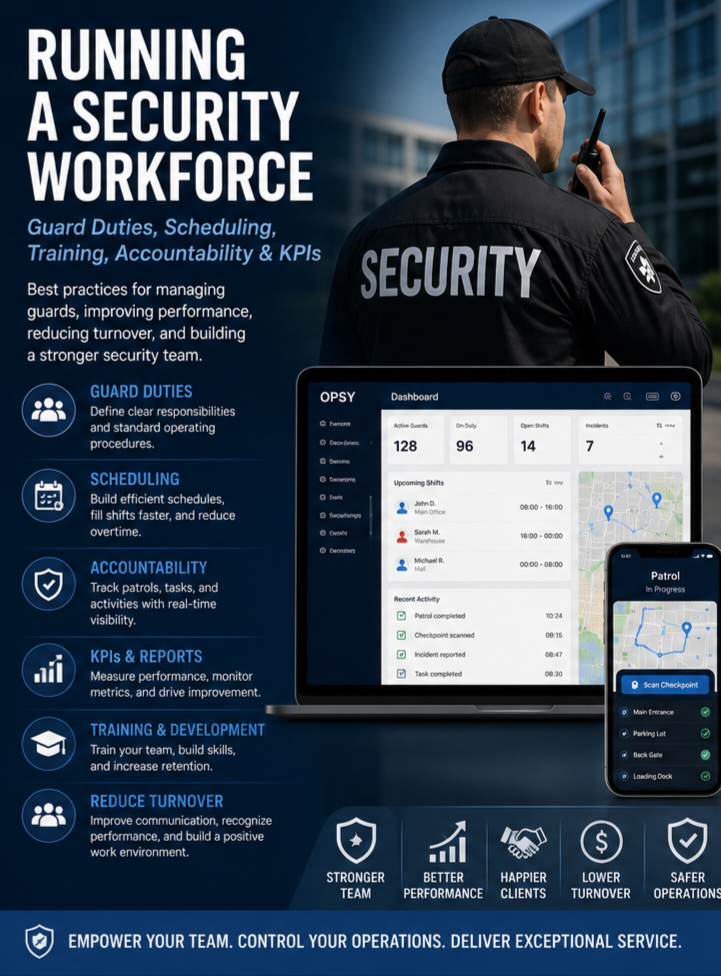
Running a Security Workforce: A Complete Guide to Managing Security Guards Successfully
Managing a security workforce involves much more than assigning guards to shifts. Today's security companies must coordinate employees across multiple locations, ensure consistent service quality, maintain compliance, reduce turnover, and provide clients with complete operational visibility.
As companies grow, manual processes such as spreadsheets, paper reports, and phone calls quickly become inefficient. Without standardized procedures and reliable workforce management systems, scheduling conflicts, communication issues, and inconsistent service become increasingly common.
This guide explains the key components of successful security workforce management, including guard responsibilities, scheduling, training, accountability, performance measurement, and employee retention.
Understanding Security Guard Duties
Every successful security operation starts with clearly defined responsibilities.
Although duties vary depending on the client and site, most security guards perform a combination of preventive, observational, and response activities.
Common responsibilities include:
- Monitoring assigned areas
- Conducting routine patrols
- Controlling access points
- Verifying visitor credentials
- Responding to alarms
- Reporting incidents
- Documenting daily activities
- Assisting during emergencies
- Observing suspicious behavior
- Protecting people and property
Clearly documented responsibilities improve consistency, simplify onboarding, and help clients understand the value your team provides.
Assign Duties Through Post Orders and SOPs
Even experienced guards need clear guidance.
Every location should have:
- Site-specific Post Orders
- Standard Operating Procedures (SOPs)
- Emergency response instructions
- Client-specific requirements
- Patrol schedules
- Communication procedures
Providing written instructions helps eliminate confusion and ensures every guard follows the same operational standards.
Building Efficient Guard Schedules
Scheduling is one of the most challenging responsibilities for security operations managers.
Missed shifts, overtime, last-minute absences, and changing client requirements can quickly disrupt operations.
An effective scheduling process should consider:
- Guard availability
- Certifications and licenses
- Required experience
- Site-specific training
- Shift preferences
- Labor regulations
- Overtime limits
Digital scheduling platforms reduce manual work, minimize conflicts, and allow supervisors to react quickly to unexpected changes.
Common Scheduling Challenges
Security companies frequently face:
- Last-minute call-offs
- Double-booked guards
- Unfilled shifts
- Excessive overtime
- Manual scheduling errors
- Communication delays
Addressing these issues requires both well-defined processes and modern workforce management tools.
Reducing Security Guard Turnover
Employee turnover is one of the largest operational costs for security companies.
Replacing experienced guards involves recruiting, onboarding, training, scheduling, and administrative work—all of which increase costs and can impact service quality.
Common reasons guards leave include:
- Inconsistent schedules
- Limited career growth
- Poor communication
- Low engagement
- Lack of recognition
- Insufficient training
- Burnout from excessive overtime
Reducing turnover starts with creating a supportive work environment where guards feel informed, valued, and equipped to succeed.
Improving Guard Accountability
Clients expect security providers to demonstrate that guards are completing assigned duties consistently.
Accountability is built through transparency, not micromanagement.
Effective accountability practices include:
- GPS-verified patrols
- Digital checkpoint scans
- Time-stamped task completion
- Incident reporting
- Supervisor inspections
- Activity logs
- Performance reviews
Providing measurable evidence of completed work builds trust with clients and improves internal performance management.
Measuring Performance with Security KPIs
What gets measured gets improved.
Security companies should establish Key Performance Indicators (KPIs) to monitor service quality, operational efficiency, and workforce performance.
Useful KPIs include:
Shift Coverage Rate. Measures the percentage of scheduled shifts that are successfully staffed.
Patrol Completion Rate. Tracks whether all required patrols were completed on time.
Incident Response Time. Measures how quickly guards respond to incidents or alarms.
Missed Checkpoints. Identifies patrol gaps and potential compliance issues.
Report Submission Time. Evaluates how quickly incident reports are completed after an event.
Overtime Hours. Helps identify scheduling inefficiencies and reduce labor costs.
Employee Retention Rate. Measures workforce stability over time.
Client Satisfaction. Regular client feedback provides valuable insight into service quality and areas for improvement.
Monitoring KPIs allows managers to identify trends, address issues early, and continuously improve operations.
Training Security Guards for Long-Term Success
Training should not end after onboarding.
Ongoing development helps guards remain confident, compliant, and prepared for changing security challenges.
Training topics may include:
- Customer service
- Conflict de-escalation
- Emergency response
- Patrol techniques
- Incident reporting
- Access control
- Workplace safety
- Technology usage
- Company SOPs
- Site-specific procedures
Companies that invest in continuous learning often experience higher employee engagement and lower turnover.
Standardize Communication
Effective communication connects every part of a security operation.
Managers, supervisors, dispatchers, clients, and guards should all have access to timely and accurate information.
Important communication practices include:
- Shift briefings
- Digital announcements
- Emergency notifications
- Daily activity reports
- Supervisor feedback
- Client updates
Clear communication reduces misunderstandings and supports faster decision-making.
Use Technology to Support Workforce Management
Modern security companies increasingly rely on digital platforms to manage daily operations.
Workforce management software can simplify:
- Guard scheduling
- Shift management
- Patrol tracking
- Task assignment
- Incident reporting
- GPS verification
- Performance monitoring
- Client reporting
- Document management
Replacing paper-based workflows with digital tools improves operational efficiency and provides greater visibility across all locations.
Best Practices for Running a Security Workforce
Successful security companies typically follow several operational best practices:
- Clearly define guard responsibilities.
- Maintain up-to-date Post Orders and SOPs.
- Automate scheduling whenever possible.
- Monitor workforce KPIs regularly.
- Invest in ongoing training.
- Conduct regular supervisor inspections.
- Encourage open communication.
- Recognize high-performing employees.
- Review client feedback consistently.
- Continuously improve operational processes.
Together, these practices help create reliable, scalable security operations.
Common Workforce Management Mistakes
Avoid these common challenges:
- Relying on manual scheduling.
- Failing to update procedures.
- Providing inconsistent training.
- Measuring only attendance instead of performance.
- Delaying incident reporting.
- Ignoring employee feedback.
- Overusing overtime.
- Lacking operational visibility.
Small operational issues can quickly grow into larger service problems if left unresolved.
Frequently Asked Questions
What are the primary duties of a security guard?
Security guards monitor property, conduct patrols, control access, respond to incidents, report observations, and help maintain a safe environment.
How can security companies reduce employee turnover?
Providing clear communication, predictable schedules, career development opportunities, and ongoing training can improve employee satisfaction and retention.
Which KPIs should security companies monitor?
Common KPIs include shift coverage, patrol completion, response times, overtime, incident reporting, employee retention, and client satisfaction.
Why is accountability important in security operations?
Accountability demonstrates that guards are performing assigned duties correctly, strengthens client trust, and supports continuous operational improvement.
Final Thoughts
Managing a security workforce requires balancing people, processes, and technology. As organizations grow, maintaining consistency becomes increasingly difficult without standardized procedures and reliable operational tools.
Successful security companies invest in clear guard responsibilities, structured scheduling, continuous training, measurable KPIs, and transparent reporting. These practices not only improve internal efficiency but also strengthen client confidence and long-term business growth.
By combining experienced personnel with modern workforce management technology, security providers can deliver safer, more accountable, and more scalable operations.