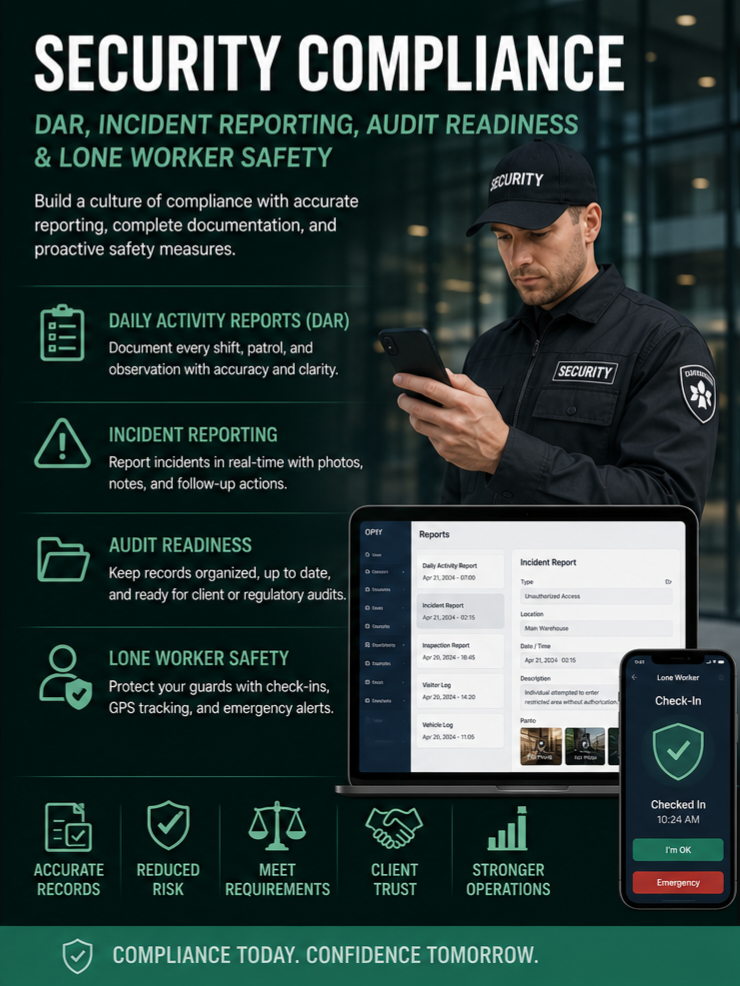
Security Compliance: A Complete Guide to Reporting, Audit Readiness & Lone Worker Safety
Compliance is one of the foundations of a professional security operation. Clients expect security providers not only to protect people and property but also to document activities accurately, respond consistently to incidents, and demonstrate that every procedure follows agreed standards.
Without structured documentation and standardized processes, even a well-trained security team can struggle during client reviews, regulatory inspections, or internal audits.
This guide explains how security companies can strengthen compliance through effective Daily Activity Reports (DARs), incident reporting, audit readiness, and lone worker safety programs.
Why Compliance Matters in Security Operations
Compliance is more than following regulations—it is about building trust.
Strong compliance practices help security companies:
- Demonstrate professionalism
- Meet contractual obligations
- Reduce operational risk
- Improve accountability
- Protect employees
- Support legal investigations
- Build long-term client relationships
Organizations with well-documented procedures are also better positioned to win new contracts, especially in highly regulated industries such as healthcare, logistics, education, and critical infrastructure.
Daily Activity Reports (DAR): The Foundation of Security Documentation
A Daily Activity Report (DAR) records everything a security officer observes and does during a shift.
Rather than documenting only unusual events, a DAR provides a complete operational record of routine activities.
Typical entries include:
- Shift start and end times
- Patrols completed
- Visitor activity
- Deliveries
- Access control events
- Equipment inspections
- Safety observations
- Maintenance issues
- Client requests
- General site conditions
Well-written DARs provide valuable evidence of the services delivered and create transparency for both supervisors and clients.
Best Practices for Daily Activity Reports
To ensure consistency and usefulness, every DAR should be:
Accurate. Record only factual observations. Avoid assumptions or personal opinions.
Timely. Complete reports during or immediately after each activity whenever possible.
Clear. Use concise language that anyone reviewing the report can understand.
Complete. Include dates, times, locations, names, and any actions taken.
Consistent. Use standardized report formats across all sites and teams.
Digital reporting tools help enforce consistency and reduce missing information.
Incident Reporting: Documenting Critical Events
Unlike a DAR, which covers routine activities, an incident report focuses on a specific event that requires attention.
Common incidents include:
- Unauthorized access
- Theft
- Property damage
- Workplace injuries
- Fire alarms
- Medical emergencies
- Suspicious behavior
- Equipment failures
- Trespassing
- Safety hazards
Proper incident documentation protects both the client and the security provider.
What Every Incident Report Should Include
An effective report should answer the following questions:
- What happened?
- When did it happen?
- Where did it happen?
- Who was involved?
- What actions were taken?
- Was law enforcement or emergency services contacted?
- Were photographs or evidence collected?
- What follow-up is required?
Reports should remain objective and avoid speculation.
Whenever possible, supporting photos, videos, or witness statements should be attached.
Preparing for Security Audits
Audits are a routine part of many security contracts.
Clients may request evidence that guards are following agreed procedures and contractual obligations.
Common audit areas include:
- Patrol completion records
- Shift attendance
- Incident reports
- Training records
- Equipment inspections
- License verification
- Certification records
- Post Orders
- SOP compliance
Companies that maintain accurate records throughout the year are significantly better prepared for audits.
Building an Audit-Ready Security Operation
Audit readiness is an ongoing process rather than a one-time effort.
Consider implementing these practices:
Standardized Documentation. Use the same reporting format across every location.
Digital Record Storage. Maintain searchable records instead of paper files.
Regular Internal Reviews. Conduct periodic checks to identify missing documentation before external audits.
Version-Controlled Procedures. Ensure guards always work from the latest SOPs and Post Orders.
Supervisor Verification. Regular reviews by supervisors improve documentation quality and operational consistency.
Lone Worker Safety
Many security officers work independently, especially during overnight shifts, mobile patrols, or remote site assignments.
Working alone introduces additional safety risks that require structured procedures.
Potential risks include:
- Medical emergencies
- Workplace violence
- Environmental hazards
- Delayed emergency response
- Communication failures
- Fatigue
Employers have a responsibility to reduce these risks through appropriate policies and technology.
Best Practices for Protecting Lone Workers
A comprehensive lone worker safety program should include:
Regular Check-Ins. Require guards to check in at scheduled intervals.
GPS Location Monitoring. Location verification helps supervisors confirm that guards are safe and performing assigned duties.
Emergency Communication. Provide reliable communication channels for requesting immediate assistance.
Panic or Duress Alerts. Guards should have access to emergency alert functionality for high-risk situations.
Site Risk Assessments. Evaluate each location to identify hazards before assigning personnel.
Emergency Response Procedures. Ensure every lone worker understands how to respond during emergencies.
Using Technology to Improve Compliance
Technology has become an essential part of modern security operations.
Digital platforms help companies:
- Complete Daily Activity Reports
- Submit incident reports from the field
- Verify patrol completion
- Track guard locations
- Store compliance records
- Generate audit documentation
- Share reports with clients
- Maintain complete activity histories
Replacing paper forms with digital workflows improves accuracy, speeds up reporting, and provides greater operational visibility.
Common Compliance Mistakes
Even experienced security companies sometimes encounter compliance issues.
Common mistakes include:
- Incomplete Daily Activity Reports
- Delayed incident reporting
- Missing patrol documentation
- Outdated SOPs
- Inconsistent Post Orders
- Lost paper records
- Poor supervisor oversight
- Limited audit preparation
Addressing these issues proactively helps reduce operational and legal risk.
Compliance Checklist for Security Companies
A strong compliance program should include:
- Standardized Daily Activity Reports
- Digital incident reporting
- Current SOPs and Post Orders
- Training records
- Patrol verification
- Audit-ready documentation
- Lone worker safety procedures
- Supervisor inspections
- Regular compliance reviews
- Secure record storage
Frequently Asked Questions
What is a Daily Activity Report (DAR)?
A Daily Activity Report is a record of routine security activities completed during a shift, including patrols, observations, visitor activity, and site conditions.
What is the difference between a DAR and an incident report?
A DAR documents routine daily activities, while an incident report focuses on a specific event such as a theft, injury, alarm, or unauthorized access.
Why is audit readiness important?
Being audit-ready allows security companies to demonstrate compliance with client requirements, contractual obligations, and internal procedures without scrambling to gather documentation.
How can technology improve compliance?
Digital workforce management platforms simplify reporting, centralize records, improve accountability, and make compliance documentation easier to access during audits.
Final Thoughts
Compliance is not simply about meeting regulatory requirements—it is about creating consistent, transparent, and accountable security operations.
Organizations that invest in standardized reporting, audit preparation, and lone worker safety build stronger client relationships, reduce operational risk, and improve overall service quality.
As security operations become more complex, digital tools play an increasingly important role in helping companies maintain accurate records, support field teams, and stay prepared for audits at any time.